
Overcome Depression Naturally with Science-Backed Lifestyle Changes

Craig Allen • April 14, 2023
deeply depressed woman

Depression can be a devastating and all-encompassing experience. It is much more than feeling down or blue; it can rob people of their daily joys and physical complications. Thankfully with understanding care and support, relief from depression symptoms is possible, reminding us there is light at the end of any dark tunnel. 


When managing depression, making small lifestyle changes can make a big difference.


1. Regular exercise

Caring for your emotional well-being is so important, and physical exercise can be one great way to do this. Half an hour of moderately intense activity, such as going for a brisk walk or cycling, releases endorphins into the brain that help improve mood and reduce depression symptoms. If you're not used to regular exercise, start small - 10-15-minute sessions are perfect! And remember, it's also essential to find something just right for you; pick out activities you enjoy, like sports classes or even exploring different places in nature while walking. Exercising will boost your mental health, support sound sleep quality, and improve overall self-esteem.


2. Eating a Well-Balanced Diet

Eating a nutrient-rich diet, such as the Mediterranean-style one emphasising fruits, veggies, whole grains and healthy fats, is essential to mental health. Essential fatty acids like omega 3s are known for their powerful impact on brain health and have been found in studies to reduce symptoms of depression when present at ideal levels in the body. Ensuring your meals include these delicious supportive foods can help regulate blood sugar, affecting mood, as excess processed and sugary foods can significantly impact our well-being. Not only are they linked to increased inflammation, but this fuel could even cause feelings of depression.


3. Sleep

Sleep and mental health both influence one another greatly. Quality sleep can help maintain the balanced production of mood-regulating neurotransmitters, reduce stress by fighting off inflammation, and even battle depression to break the domino effect that ensues when insomnia becomes a comorbidity with it.

 To make sure you're getting enough restful sleep each night to keep these benefits going strong, aim for a regular 7-9 hours by establishing a consistent bedtime routine that includes no late-night caffeine or electronics close to lights out! 


4. Connections 

It's easy to feel overwhelmed and alone when faced with depression, but having a solid social support system can make all the difference. Reconnecting or building relationships, such as talking about your feelings openly and spending time with supportive friends and family members, not only provides comfort during hard times but also helps relieve stress levels and boosts self-confidence - ultimately creating an uplifting sense of belonging. Or, if you're feeling particularly isolated, consider joining a local group of people going through similar experiences. Take your time with this path!

Feeling supported during hard times can make all the difference. Whether you prefer to connect with others in person or online, seeking out a support group is an empowering choice that offers connection and belongingness. You'll find individuals who understand your experiences and helpful tips from experts on effectively coping with whatever's going on for you - like learning new strategies, building friendships, and more! Plus, mental health organisations are available that have resources ready at hand if you need additional guidance getting started.


5. Stop Those Negative Thoughts

Negative thoughts can be a telltale sign of depression and are challenging to manage. Cognitive distortions are unhealthy reactions based on our assumptions and beliefs rather than reality. They tend to hijack our perspective without warning, and it's difficult for us to see the truth behind them, much less break free from their grasp — especially when we think things like "I'm never going to make it" or "Nothing good ever happens." Recognising these patterns is essential in gaining control over negative thinking. Getting caught up in our negative thoughts can be so easy. However, taking the time to challenge them is how we can develop more balanced and realistic thinking patterns that better serve us. To do this, try reframing or reappraisal - both involve looking at a situation from different perspectives for increased understanding or reducing its emotional impact on you, respectively. Ultimately it's about seeing mistakes as opportunities instead of failures!


6. Setting Goals

It can be tough to feel motivated when struggling with depression. However, setting attainable goals is a great way to build self-esteem and get back on track! Start by setting small objectives to help improve your outlook. Take daily strolls or cook nourishing meals every week. Be precise – instead of saying 'exercise more' make it measurable, like walking for 30 minutes daily. Each success feels fantastic and gives the motivation to aim higher in life!


7. Be Gentle On Yourself 

It's natural to feel like you're alone when struggling with depression, but taking the time for self-compassion can help give a much-needed boost of kindness. Offering yourself supportive care and understanding is just as important as showing caring towards loved ones - so why not start by providing some love back to your heart? Remember that difficult times are part of being human; it doesn't mean there's something wrong or bad about you. Find ways to be mindful in day-to-day moments – practice deep breathing, take walks outside and connect with nature, listen to soothing music…the list goes on! Showing compassion towards our inner selves will nourish both mental health and overall well-being.


Final Word

In conclusion, depression is a difficult condition to manage, but it is possible to find relief through different approaches. It can also be helpful to use natural remedies, such as exercise and cognitive behaviour therapy, in combination with medication. Another promising treatment for depression is hypnotherapy. Although this form of psychotherapy is still relatively new, many studies have found it to be beneficial for those suffering from low moods. To ensure that you receive the most effective treatment possible, make sure to consult an expert in the field before trying hypnotherapy or any other alternative treatments. Remember that depression cannot always be conquered alone and professional help may be essential for long-term success. With the right approach, there can be hope that one day you will overcome your depression and start living life on your own terms once again.


For those in Canberra, I am now available for face-to-face consultations. Those interstate or overseas need not miss out either! Online Zoom sessions allow us to connect no matter where you are based.

Person in jeans sits in an armchair, hands clasped. Someone else holds a clipboard and pen.
By Craig Allen January 7, 2026
From hypnotherapy to MAT, this 2026 guide breaks down the best addiction treatments across Australia. Learn what works and why.
By Craig Allen January 3, 2026
By Craig Allen – Clinical Hypnotherapist & Strategic Psychotherapist, Canberra Summary This article explains how clinical hypnotherapy and strategic psychotherapy use neuroplasticity to interrupt anxiety and addiction patterns, based on lived experience and real clinical practice at Inspired Mindset in Canberra. Introduction: Why Insight Alone Often Isn’t Enough I don’t teach neuroplasticity because I read it in a textbook. I teach it because I lived it. Years ago, I was stuck in a repeating loop of addiction. I tried willpower. I tried logic. I tried traditional talk therapy. I understood why I was doing what I was doing — but nothing actually changed. What finally worked was learning how the brain forms highly efficient automatic patterns, and how those patterns can be updated rather than fought. Through Strategic Psychotherapy and Clinical Hypnosis, I learned how to dismantle the old “addiction highway” my brain had built and replace it with a different operating system altogether. Today, at Inspired Mindset Hypnotherapy Canberra, I use that same understanding to help clients realise something critical: You are not broken. You have a very efficient brain running an unhelpful strategy. Once the strategy changes, the struggle often reduces dramatically. What This Article Explains This article is for people who: Understand why they struggle with anxiety or addiction Have insight but still feel controlled by automatic reactions Feel “stuck” despite intelligence, motivation, or previous therapy It explains how neuroplasticity-based approaches, such as hypnotherapy and strategic psychotherapy, work at the level of subconscious patterns — not willpower alone — and why this matters in real clinical practice. What is Neuroplasticity-Based Hypnotherapy? Definition: Neuroplasticity-based hypnotherapy is a clinical approach that uses the brain's natural ability to form new neural pathways to interrupt automatic anxiety and addiction loops. Unlike talk therapy, which engages the logical mind, this method targets the subconscious "pattern" to update the nervous system's response. Neuroplasticity: The Inspired Mindset Roadmap Your brain is plastic. That means it can change at any age — not through force, but through targeted learning. Research consistently supports the brain's ability to reorganize itself by forming new neural connections throughout life, a principle that is fundamental to modern clinical hypnotherapy. At Inspired Mindset, our integrated approach follows a simple, clinically grounded three-step roadmap. 1. Pattern Identification – The Strategy Using Strategic Psychotherapy, we map how the problem runs. This includes: Cognitive distortions Emotional triggers Situational patterns The exact moment the “hijack” occurs This step answers the question: “What is the pattern, and how does it keep repeating?” Dive Deeper: If you are unsure which therapy fits your needs, read our detailed comparison: Hypnotherapy vs CBT vs Coaching: What Works Best for Anxiety? 2. Pattern Interruption – The Hypnosis Hypnosis works by reducing the interference of the part of the mind that says: “This won’t work” “I’ve always been like this” “I should be over this by now” In a focused hypnotic state, the brain becomes more receptive to updating learned emotional responses. This allows us to: Interrupt automatic anxiety or craving loops Reduce physiological over-reaction Create new emotional associations This is not loss of control. It is access to a learning state the brain already uses naturally. Further Reading: Curious about the science? We break it down in Does Hypnotherapy Really Work? Here’s What to Know . 3. Future-Proofing – The Coaching Once the old loop is weakened, we build forward momentum. Through Mindset Coaching, we: Reinforce new habits Strengthen identity shifts Prevent relapse into old patterns Build confidence through action This ensures the change isn’t just a temporary feeling — but a durable behavioural shift. Who Is Strategic Psychotherapy and Hypnotherapy For? This is not relaxation or surface-level mindset work. In my Canberra CBD clinical practice, this approach is particularly effective for: Panic and phobias – where the body reacts before thought Addictive behaviours – where cravings feel automatic and overpowering. (See also: Hypnotherapy for Addiction or our guide on Hypnosis for Gambling High-functioning anxiety – overthinking, control, and nervous-system overload Executive burnout – chronic amygdala activation under sustained pressure Related Guide: Learn more about our specific approach to Hypnotherapy for Anxiety & Depression . Does Hypnotherapy Work When Talk Therapy Hasn’t? Often, yes — particularly when insight is already present. Many clients understand their anxiety or addiction intellectually, yet still experience strong physical responses. In these cases, hypnotherapy can help by addressing the conditioned nervous-system reaction, not just conscious thought. This is why people often seek hypnotherapy after traditional approaches plateau. Who This Approach May Not Be Suitable For This work is not a replacement for: Acute psychiatric care Emergency mental health intervention Medical treatment Individuals experiencing active psychosis, unmanaged bipolar disorder, or immediate safety risks should seek appropriate medical or crisis services. Real Experience, Not Just Theory “I don’t just teach these methods; I used these exact tools to overcome my own addiction. This isn’t theory — it’s a roadmap I’ve lived.” — Craig Allen, Clinical Hypnotherapist “I tried traditional psychology for years. It helped me understand my anxiety, but the physical response didn’t change. After several hypnotherapy sessions with Craig, the anxiety response finally settled.” — Canberra Client Conclusion: You Don’t Have to Fight Your Brain Willpower is an exhaustible resource. Your subconscious is not the enemy — it’s an engine. When that engine is running the wrong program, life feels like a constant battle. When the program changes, effort drops away. If you’re ready to move past understanding why and start changing how, this work may be a good fit. Frequently Asked Questions (FAQ) Can hypnotherapy really change my brain? Yes. Through neuroplasticity, hypnotherapy helps "prune" old neural pathways (anxiety loops) and strengthen new ones (calm responses), effectively updating the brain's automatic software. Is this different from standard meditation? Yes. While meditation focuses on observation and mindfulness, Strategic Psychotherapy and Hypnotherapy are active interventions designed to dismantle specific triggers and install new behavioral patterns. How many sessions are typically needed? Unlike long-term talk therapy, this approach is brief and solution-focused. While every client is different, many people experience significant shifts within 3 to 6 sessions. Ready to Take the Next Step? If you’re in Canberra or looking for online hypnotherapy, you can book a free, no-pressure discovery call to discuss whether this approach is right for you. 👉 Book a Free 15-Minute Discovery Call with Craig Allen 👉 Explore Anxiety & Addiction Treatment Packages About the Author Craig Allen is a Certified Clinical Hypnotherapist and Strategic Psychotherapist based in Canberra. His work integrates clinical training with lived experience to help clients break free from anxiety, addiction, and entrenched behavioural patterns. At Inspired Mindset, Craig combines clinical hypnotherapy, strategic psychotherapy, and evidence-based coaching to support lasting change — not just symptom management.
By Craig Allen January 2, 2026
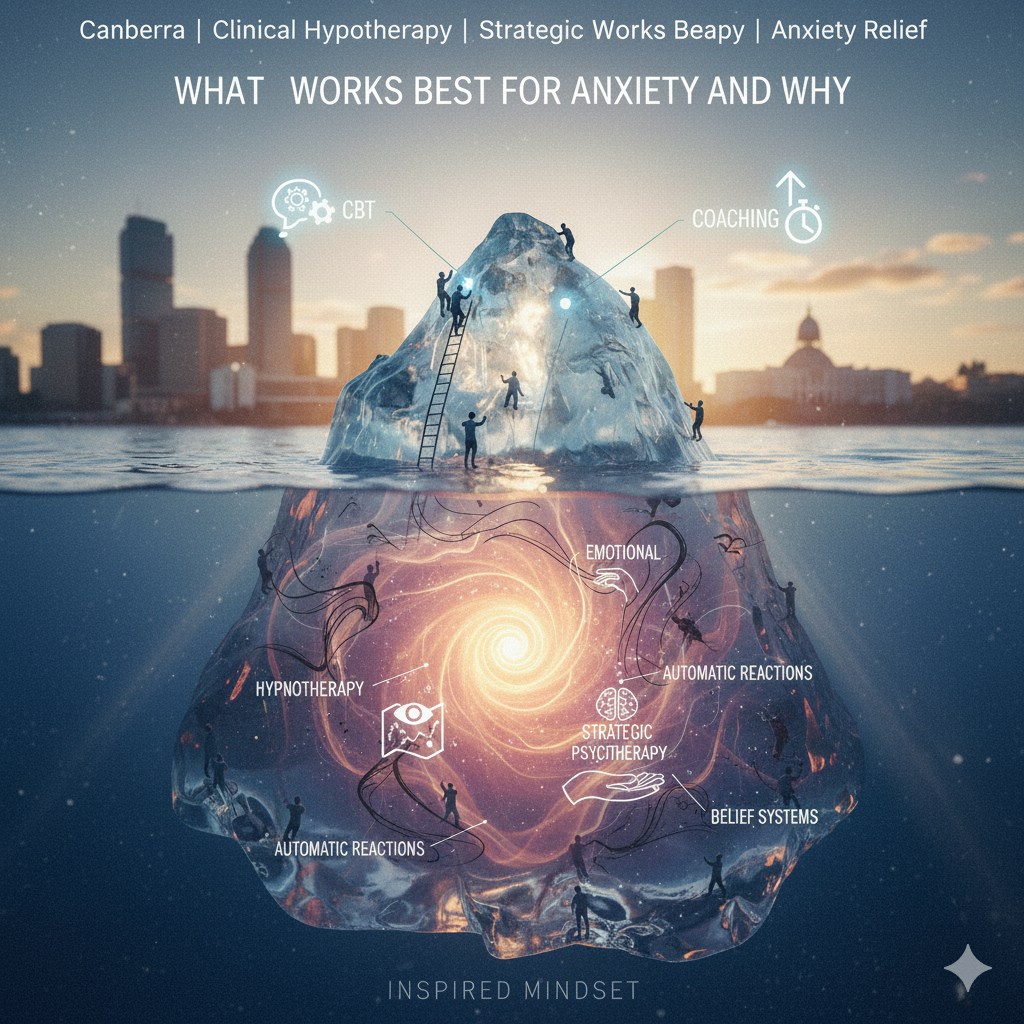
Struggling with anxiety in Canberra? Compare CBT, Life Coaching, and Clinical Hypnotherapy to find the root cause. Discover why an integrated approach works best.
Group of people in a circle, conversing in a light-filled room. They are diverse in age and race.
By Craig Allen September 13, 2025
Workplaces thrive when mental health is prioritised. Learn how corporate wellness programs can support both compliance and performance.
woman eating on a couch
By Craig Allen July 3, 2025
Emotional eating isn't about willpower. This blog reveals mindset strategies to break cravings and build long-term food freedom. Read more.
two injector dosing pens with yellow measuring tape around it
By Craig Allen July 3, 2025
From blood sugar to body weight—Ozempic is trending, but not without concerns. Find out why hypnotherapy may be a safer route. Read on.
A woman is laying on a couch while a man writes in a notebook.
By Craig Allen June 10, 2025
Inspired Mindset Hypnotherapy explores whether hypnosis works, how it’s used, and what the science says. Real results for smoking, anxiety, and more. Read on.
A woman is sitting on the floor surrounded by shadows of hands.
By Craig Allen June 10, 2025
Hypnosis targets the subconscious patterns behind phobias. This blog unpacks methods, success rates, and expert insights. Curious if it works? Start here.
Hypnosis and client
By Craig Allen February 11, 2025
In the journey toward sustainable weight loss, many people struggle with habits and cravings rooted in the subconscious mind. Hypnotherapy offers a powerful, science-backed approach to addressing these challenges by rewiring thought patterns and fostering healthier behaviors.
a person gambling using a phone
By Craig Allen July 3, 2024
In this comprehensive guide, we dive into the nature of gambling addiction, treatment methods, and more.
  • ARE YOU READY TO TAKE THE FIRST STEP TO BUILDING A GROWTH MINDSET?

    Let Inspired Mindset provide you with the tools and methods you need to overcome difficult challenges and achieve your goals. Book a complimentary chat to discover your road to a living a happier and more fulfilling life.


    Let's Talk

I hope you enjoy reading this blog post.

Inspired Mindset helps ease physical, mental, emotional, behavioural (i.e. smoking, addiction and weight loss), and psychological symptoms (i.e. stress, anxiety and depression), so individuals can live happy and productive lives.